 EN
EN
 jp
jp  ko
ko  fr
fr  es
es  ru
ru  pt
pt  ar
ar  th
th  vi
vi  id
id 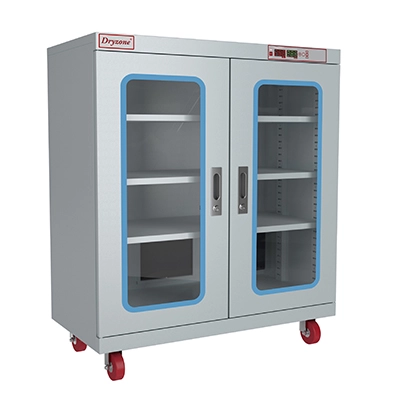
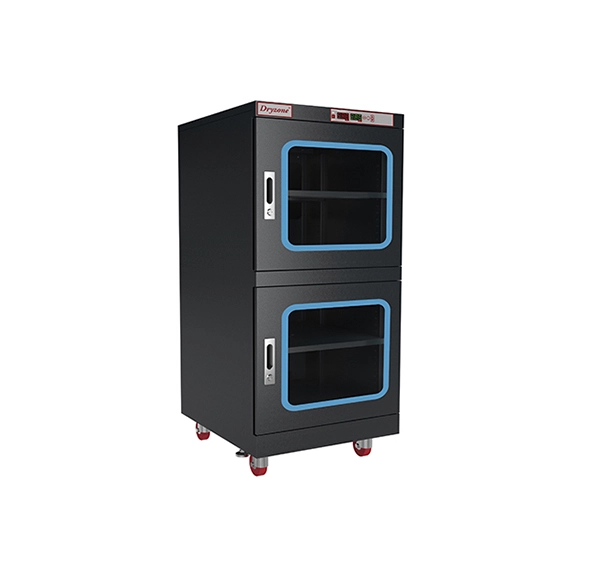


 To Know Dryzone More
For semiconductor and SMT engineers, a recurring question is: what level of humidity is truly safe for today’s most sensitive components? Standard dry cabinets, which typically maintain 10–20% RH, are sufficient for many general electronic components. However, for wafers, bare dies, MEMS sensors, and MSL 4–5a packages, this is not enough. These high-value materials require a controlled environment at <1% RH — an “ultra-low humidity” level that is technically challenging to achieve and maintain.
This level of protection is directly referenced in the specifications for Dryzone’s CF1 Series cabinets. In this article, we explore the science behind ultra-low humidity storage, the industries that require it, and how the CF1 Series delivers reliable <1% RH performance while complying with IPC/JEDEC J-STD-033 standards.
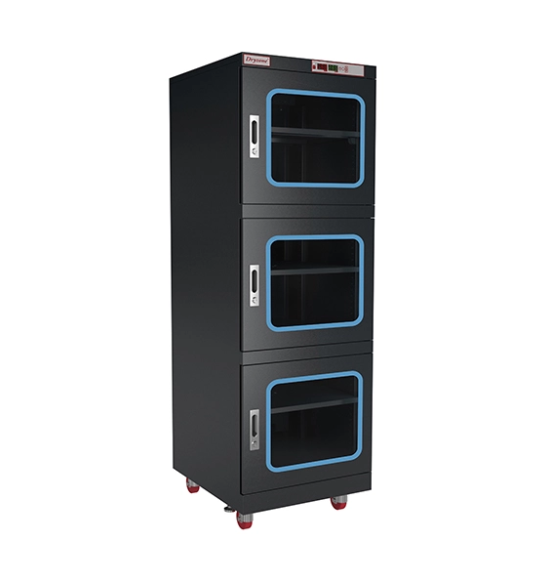
The term “low humidity” is relative and context-dependent. Not all dry cabinets provide the same protection. Selecting the right storage solution depends on your component’s sensitivity to moisture. The table below compares common storage humidity levels, their applications, and the technology required.
| Humidity Level | RH Range | Typical Applications | Required Technology |
|---|---|---|---|
| Conventional Low | 20–50% | Cameras, musical instruments, documents | Standard dry cabinet |
| Industrial Low | 10–20% | PCBs, general electronic components | Industrial drying cabinet |
| Ultra-Low | 5–10% | MSL 2–3 devices, SMT line buffers | High-performance baking dry cabinet |
| Extreme Ultra-Low | <5% | MSL 4–5a devices, semiconductor packaging | Professional ultra-low cabinet |
| Ultimate Ultra-Low | <1% | Wafers, bare dies, MEMS, photonics | Premium ultra-low cabinet (Dryzone CF1 Series) |
Key takeaway: The required humidity level depends entirely on the component’s moisture sensitivity. For the most sensitive categories, 10% RH is insufficient — only <1% RH provides reliable protection.
Unpackaged wafers and bare dies have exposed metal bond pads, often copper or aluminum. Even trace moisture leads to oxidation. Oxide layers increase electrical resistance and can cause wire bonding failures. A 2018 study by the IEEE Transactions on Components, Packaging and Manufacturing Technology reported that copper bond pads stored at 25°C / 15% RH for 30 days exhibited a 30–40% reduction in bond shear strength. In contrast, pads stored in a <1% RH environment showed negligible change over the same period.
MEMS devices contain microscopic moving structures measured in microns. Moisture increases stiction — the static friction that can permanently bond these tiny parts together. Many MEMS datasheets now explicitly require storage at ≤5% RH. For high-reliability applications (automotive gyroscopes, medical sensors), the requirement often falls to <1% RH.
Optical coatings, anti-reflective layers, and fiber-optic interfaces are sensitive to hydrolysis. Moisture can permanently alter refractive indices, degrading optical performance. Leading optoelectronics manufacturers now mandate <2% RH (often targeting <1% RH) for pre-assembly storage of photonic chips and lenses.
IPC/JEDEC J-STD-033 is the global standard for handling moisture-sensitive devices. For MSL 4, 5, and 5a components, the standard requires storage below 5% RH after exposure. Many advanced packaging facilities adopt stricter internal rules, often requiring <1% RH for BGAs, CSPs, and SiP modules prior to reflow.
Achieving <1% RH is technically demanding. Standard electronic dry cabinets face four major barriers:
Dehumidification Limits – Peltier-based systems generally stop at 10–20% RH. True ultra-low performance requires advanced desiccant technology, such as molecular sieves.
Sealing Integrity – Every hinge, port, or door gap can leak. Maintaining <1% RH demands airtight magnetic seals and precision engineering.
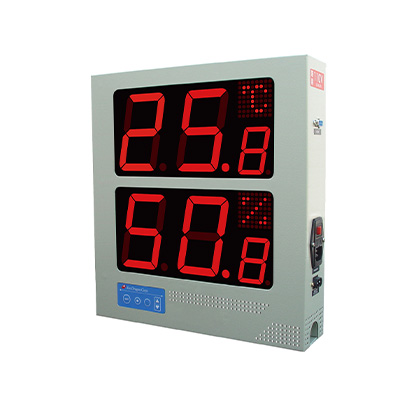
Sensor Accuracy – Low-cost humidity sensors are inaccurate below 10% RH (±10% error). Ultra-low cabinets require high-precision digital sensors with ±3% accuracy even in the low end.
Control Systems – Simple on/off control causes humidity swings. Stable <1% RH storage requires microcomputer-based PID control with fuzzy logic algorithms.
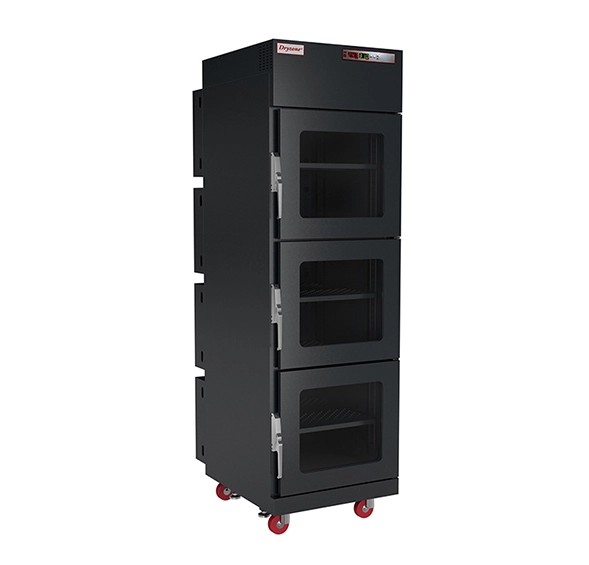
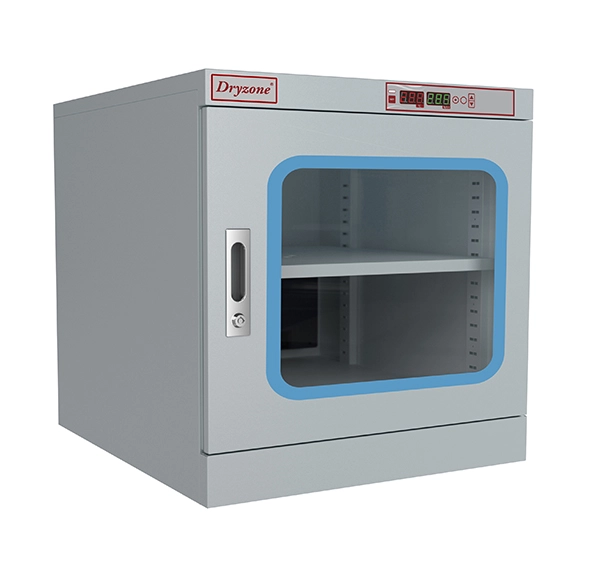
The Dryzone CF1 Series is designed to overcome these technical challenges. It is a plug-and-play, fully automatic ultra-low humidity cabinet that stabilizes at <1% RH without complex setup.
| Feature | Benefit |
|---|---|
| Modular Design | Replaceable display, power box, dehumidifier, shelves; extends life to 10–20 years |
| Green Design | Upgradable by changing modules; old modules recycled; no waste |
| Flexible Configuration | Add dehumidifier modules anytime to scale with needs |
| Plug-and-Play | Easy setup; saves operator time |
| J-STD-033B Compliant | Designed for MSD storage and floor life restoration |
| ESD Protection | Surface resistance 10⁵–10⁹ Ω; 1MΩ grounding wire included |
| Model | Capacity | Avg Power | Best Use |
|---|---|---|---|
| CF1-400 | 413L | 83W/h | Labs and R&D |
| CF1-600 | 624L | 105W/h | SMT lines, packaging |
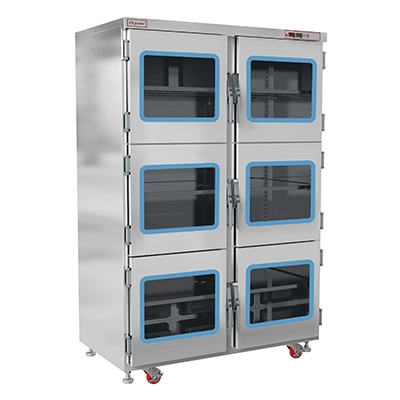
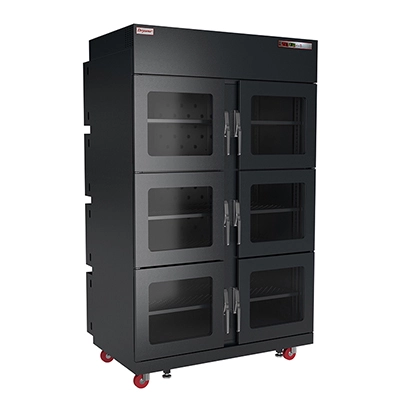
| CF1-1200-6 | 1250L | 105W/h | High-volume wafer/component storage |
| Application | Required RH | Reason |
|---|---|---|
| Wafers, bare dies | <1% | Prevent bond pad oxidation |
| MEMS (high-precision) | <1% | Avoid stiction and permanent damage |
| Photonic chips, optical coatings | <1% | Prevent coating hydrolysis |
| MSL 4–5a devices (BGA, CSP, SiP) | <5% (often <1% internally) | J-STD-033 compliance & safety margin |
| Advanced semiconductor packaging | <1% | Eliminates popcorning risk |
| Aerospace/defense electronics | <1% | Long-term reliability |
For components in these categories, an ultra-low humidity cabinet is not optional; it is essential for process control, yield protection, and long-term asset reliability.
| CF1 Model | Typical Recovery Time (<1% RH) | Notes |
|---|---|---|
| CF1-400 | 5–10 min | Small lab environments |
| CF1-600 | 7–12 min | Medium-volume SMT lines |
| CF1-1200-6 | 10–15 min | High-volume storage |
Recovery time varies depending on ambient conditions and door-open frequency. Fast recovery ensures minimal downtime during operations.
<1% RH ultra-low humidity storage is required for wafers, bare dies, MEMS, photonic components, and MSL 4–5a devices. Standard dry cabinets cannot reach this level. The Dryzone CF1 Series provides J-STD-033 compliant, modular, plug-and-play protection, offering 10–20 years of reliable service.
Q1: Is <1% RH too dry?
A: Safe for semiconductors, MEMS, and optical materials; consult component datasheets.
Q2: Do I need nitrogen?
A: No; CF1 Series uses electronic dehumidification. Nitrogen cabinets are optional for oxidation-sensitive materials.
Q3: How fast does RH recover after door opening?
A: 5–15 minutes depending on cabinet size.
Q4: Lifespan of the cabinet?
A: 10–20 years; modular upgrades extend service life.
Q5: Compliance?
A: Fully compliant with J-STD-033B for MSL 4–5a devices.
Wikipedia contributors. (2025). Dry cabinet. In Wikipedia, The Free Encyclopedia.
Wikipedia contributors. (2025). Hygrometer. In Wikipedia, The Free Encyclopedia.
IEEE. (2018). Effect of Storage Humidity on Copper Bond Pad Oxidation and Wire Bond Reliability. IEEE Transactions on Components, Packaging and Manufacturing Technology.
https://ieeexplore.ieee.org/document/8423533